In warehouse operations, space shortage is a common challenge faced by most enterprises—either restricted by the limited floor area of warehouses in urban core areas, or plagued by insufficient storage capacity and high operating costs due to the failure of traditional storage models to fully utilize vertical space. As an innovative solution to "seek space upward", the mezzanine shelving system builds detachable double-layer or multi-layer platforms inside existing warehouses. It can double the storage space without expanding the main structure of the warehouse, thus becoming a core tool to break the space bottleneck and improve storage efficiency. Based on four core advantages, this article elaborates on how the mezzanine shelving system maximizes warehouse space and its value in practical applications.
I. Core of Space Expansion: In-depth Utilization of Idle Vertical Space
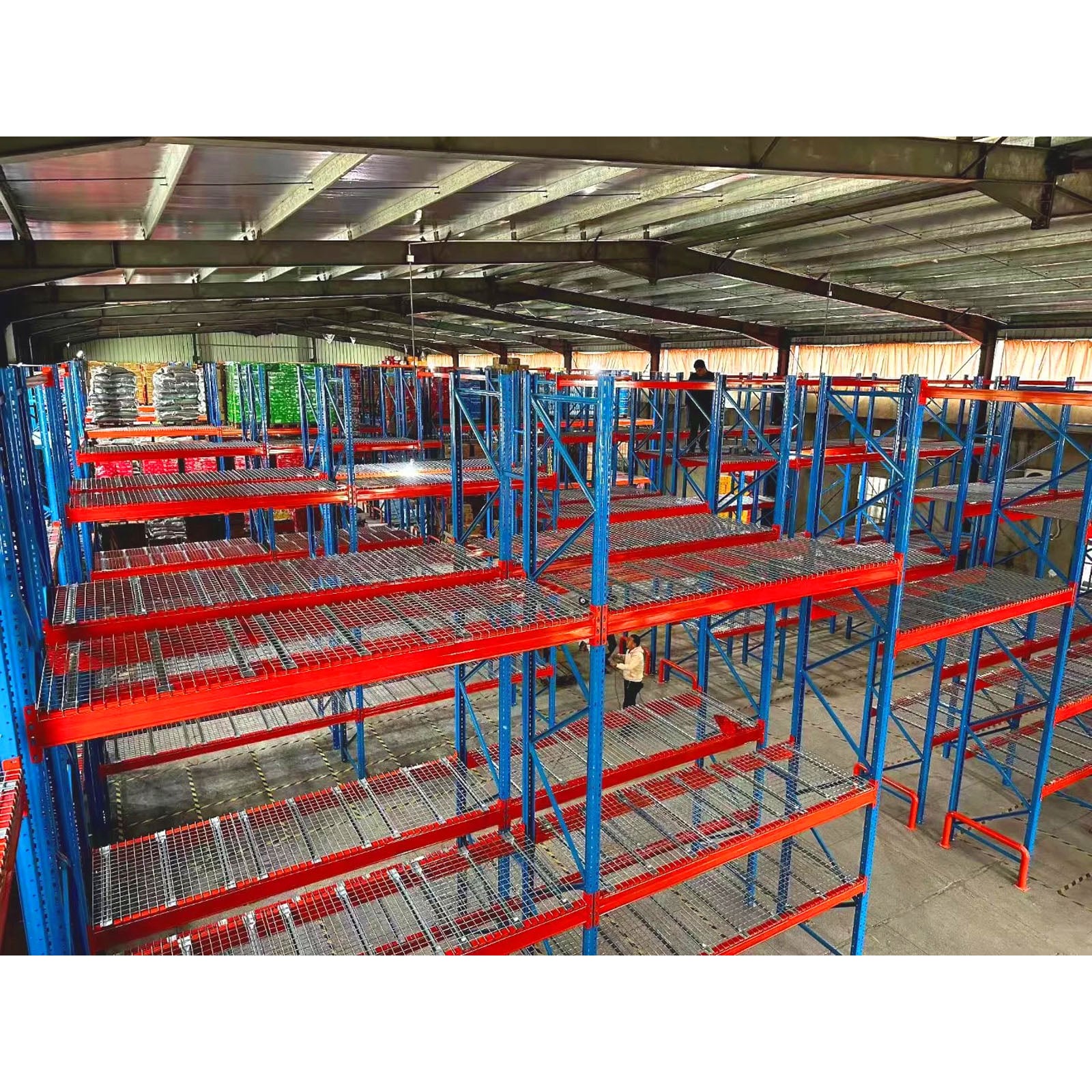
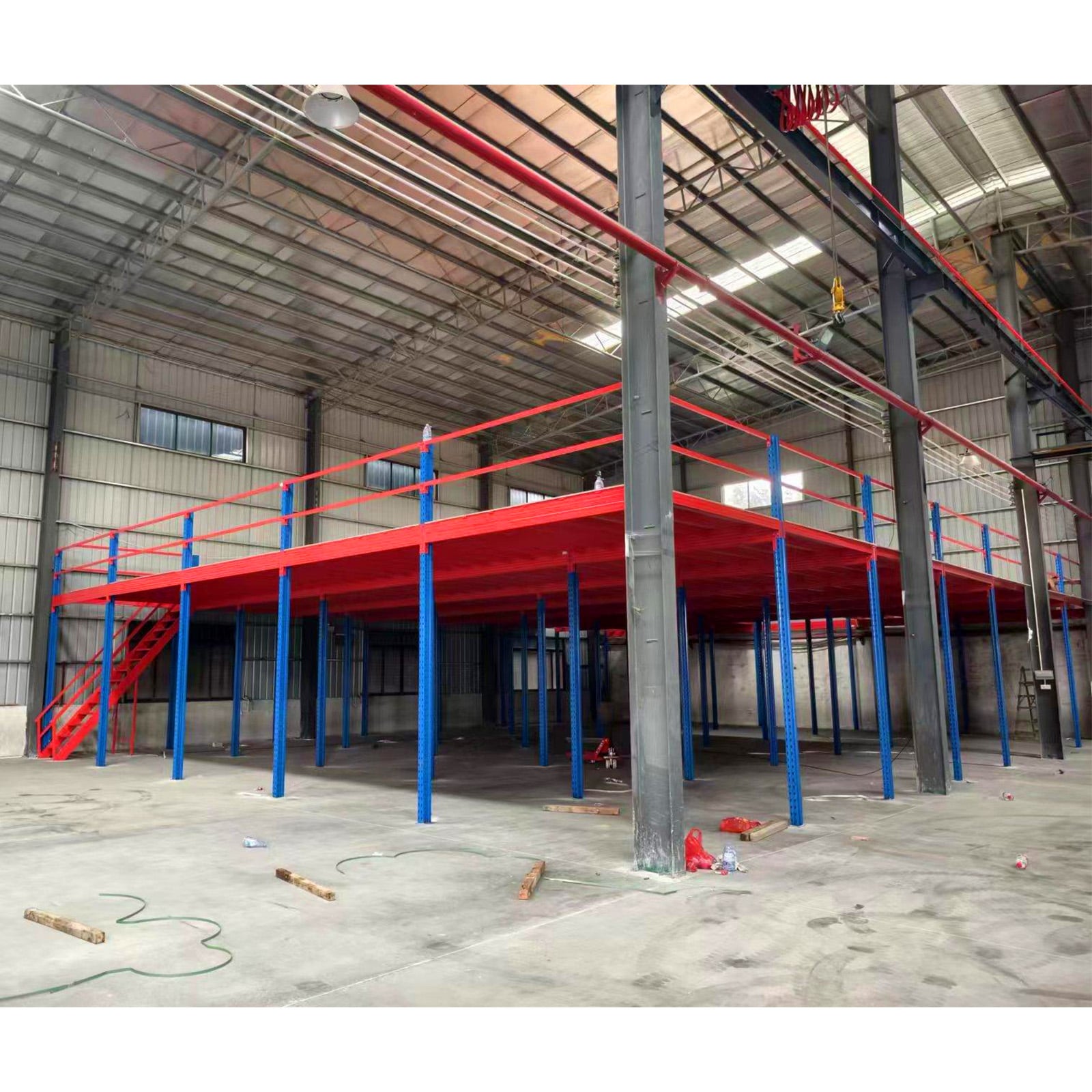
The efficiency of warehouse space utilization is often limited by the "ground-oriented mindset". Most traditional warehouses have a floor height of 5-10 meters, but only use 3-5 meters of the ground floor space, leaving a large amount of upper vertical area idle. The core value of the mezzanine shelving system is to convert this "sleeping space" into usable storage areas, achieving a leap-forward improvement in space utilization. Its expansion logic is as follows: modular mezzanine platforms are built with steel structures or cold-rolled steel, dividing the warehouse into upper and lower layers or multiple layers. The upper layer is used as a storage area for goods, while the lower layer can retain its original functions (such as ground storage, operation channels, sorting areas, etc.), forming a dual-space layout of "three-dimensional storage + ground operations".
Data shows that after building a single-layer mezzanine shelf, the warehouse storage capacity can be increased by 50%-100%; if the warehouse has sufficient floor height (more than 8 meters), building a double-layer mezzanine can increase the storage capacity by 100%-150%. An e-commerce warehouse originally had a floor height of 6 meters, with only 3.5 meters of the ground floor space used, storing about 8,000 SKUs. After building a single-layer steel structure mezzanine, the upper layer is used to store slow-moving small and medium-sized goods and spare parts, while the lower layer is concentrated on storing high-turnover goods. The storage capacity is directly increased by 60%, and the SKU carrying capacity is increased to 12,800, without increasing the warehouse floor area at all. This "vertical expansion" model does not require additional warehouse leasing or expansion, perfectly solving the space dilemma of "every inch of land is precious" for warehouses in urban core areas.
II. Adaptable Scenarios and Flexible Layout: Precisely Matching Diverse Storage Needs
The flexibility of the mezzanine shelving system enables it to adapt to different types of warehouses and cargo characteristics, further enhancing the precision of space utilization. In terms of warehouse types, e-commerce warehouses (with many SKUs, small batches, and fast turnover) can adopt the layout of "upper storage + lower picking", placing low-frequency turnover small goods on the upper layer and high-frequency picking best-selling products in the golden area of the lower layer, which not only increases storage capacity but also does not affect picking efficiency; manufacturing warehouses can use the mezzanine to store production accessories, tools or semi-finished products, freeing up ground space for storing large raw materials or equipment and optimizing the production logistics flow; cold chain warehouses can design insulated mezzanines to add low-temperature storage areas without affecting the refrigeration effect, reducing the cost of cold chain expansion.
In terms of layout methods, mezzanine shelves can be flexibly designed according to the warehouse structure: full-layer mezzanines are suitable for regular rectangular warehouses to achieve overall space expansion; partial mezzanines can be built in idle areas such as warehouse corners and column gaps to avoid space waste; the detachable modular design allows enterprises to adjust the mezzanine scale according to business fluctuations. For example, a single-layer mezzanine can be temporarily built during the e-commerce peak season to cope with inventory peaks, and disassembled in the off-season to restore the original space layout, greatly improving the flexibility of space use. In addition, the layer spacing of mezzanine shelves can be flexibly adjusted (usually 2.2-3.0 meters), which can adapt to goods of different sizes, from small and medium-sized cartons to light pallet goods, all of which can be stored stably.
III. Cost-effectiveness Advantage: A Cost-efficient Space Solution with Low Input and High Return
Compared with leasing larger warehouses or expanding warehouses, the mezzanine shelving system has significant cost advantages and is a highly cost-effective space optimization choice. In terms of input costs, the unit space investment for building mezzanine shelves is only 30%-50% of that for warehouse expansion, and the construction period is short (a single-layer mezzanine can usually be completed in 1-2 weeks) without affecting the normal operation of the warehouse. A logistics enterprise once planned to lease an adjacent warehouse to expand the storage area, which would require an annual rent increase of 800,000 yuan. However, after choosing to build a single-layer mezzanine shelf, the one-time investment was only 650,000 yuan, with a payback period of only 14 months. Subsequent annual rent costs can be saved, achieving significant long-term benefits.
In terms of operating costs, the mezzanine shelving system can reduce a variety of hidden costs: on the one hand, there is no need to hire additional warehouse managers or increase transportation costs, and the original team can manage the goods on the upper and lower layers; on the other hand, the upper storage area can centrally store low-turnover goods, reducing congestion and chaos in ground storage, and lowering the rate of cargo damage and picking errors. After optimizing with mezzanine shelves, a manufacturing warehouse reduced its cargo damage rate from 1.2% to 0.3%, cutting annual losses by about 120,000 yuan. In addition, the steel structure of mezzanine shelves has a long service life (usually 15-20 years) and can be disassembled and reused. If the enterprise relocates or adjusts its business, it can be quickly disassembled and transferred to a new warehouse, further reducing the risk of long-term investment.
IV. Synergy of Safety and Efficiency: Building a Double Guarantee for Space Expansion
The space expansion of the mezzanine shelving system does not come at the expense of safety or efficiency; instead, it achieves "equal emphasis on safety and efficiency" through scientific design. In terms of safety design, the mezzanine shelving is built with high-strength steel structures, with each layer bearing a load of up to 500-2000 kg, which can meet the storage needs of small and medium-sized goods and light pallet goods; 1.2-meter-high guardrails are installed on the edge of the platform, and anti-skid devices are set on stairs or hydraulic lifting platforms to prevent personnel or goods from falling; at the same time, it strictly complies with fire protection codes, reserving sufficient space for fire-fighting passages and sprinkler system installation to ensure the compliance of warehouse fire safety. The mezzanine shelves of an e-commerce warehouse have been certified by a third-party testing agency to withstand magnitude 8 earthquakes, and have successfully passed the fire acceptance inspection through reasonable planning of fire-fighting passages.
In terms of efficiency improvement, the mezzanine shelving system realizes efficient coordination of upper and lower layer operations by optimizing the flow line design. Goods on the upper layer can be quickly transferred to the lower layer through hydraulic lifting platforms, freight elevators or conveyors. Combined with the ABC classification method, high-turnover goods are placed in the golden picking area on the lower layer, and low-turnover goods are stored on the upper layer, shortening the average picking path by 15%-20%. After building a mezzanine in an e-commerce warehouse, the upper layer stores slow-moving goods and spare packaging materials, and the lower layer focuses on sorting best-selling products. The daily picking efficiency is increased by 25%, and the order delivery time is shortened from 4 hours to 3 hours. In addition, the modular design of mezzanine shelves allows adjusting the channel width and storage layout according to operational needs, adapting to various operation modes such as manual picking and electric forklifts, further improving operational efficiency.
Conclusion
As a core solution to maximize warehouse space, the mezzanine shelving system essentially activates idle vertical space through the concept of "vertical development" to achieve efficient expansion of storage capacity. Whether it is warehouses in space-constrained urban core areas, or e-commerce and manufacturing warehouses that need to quickly improve storage capacity, mezzanine shelves can break the space dilemma with the advantages of low input, high return and flexible adaptation. Against the background of the rapid development of the logistics industry and the continuous rise of warehousing costs, enterprises abandoning the traditional "ground expansion" mindset and choosing mezzanine shelving systems for space optimization can not only reduce operating costs, but also improve market response speed and core competitiveness. In the future, with the in-depth integration of modular, intelligent technology and mezzanine shelves, its space utilization efficiency and safety performance will be further improved, making it a mainstream choice for warehouse storage optimization.

 EN
EN
 Hot News