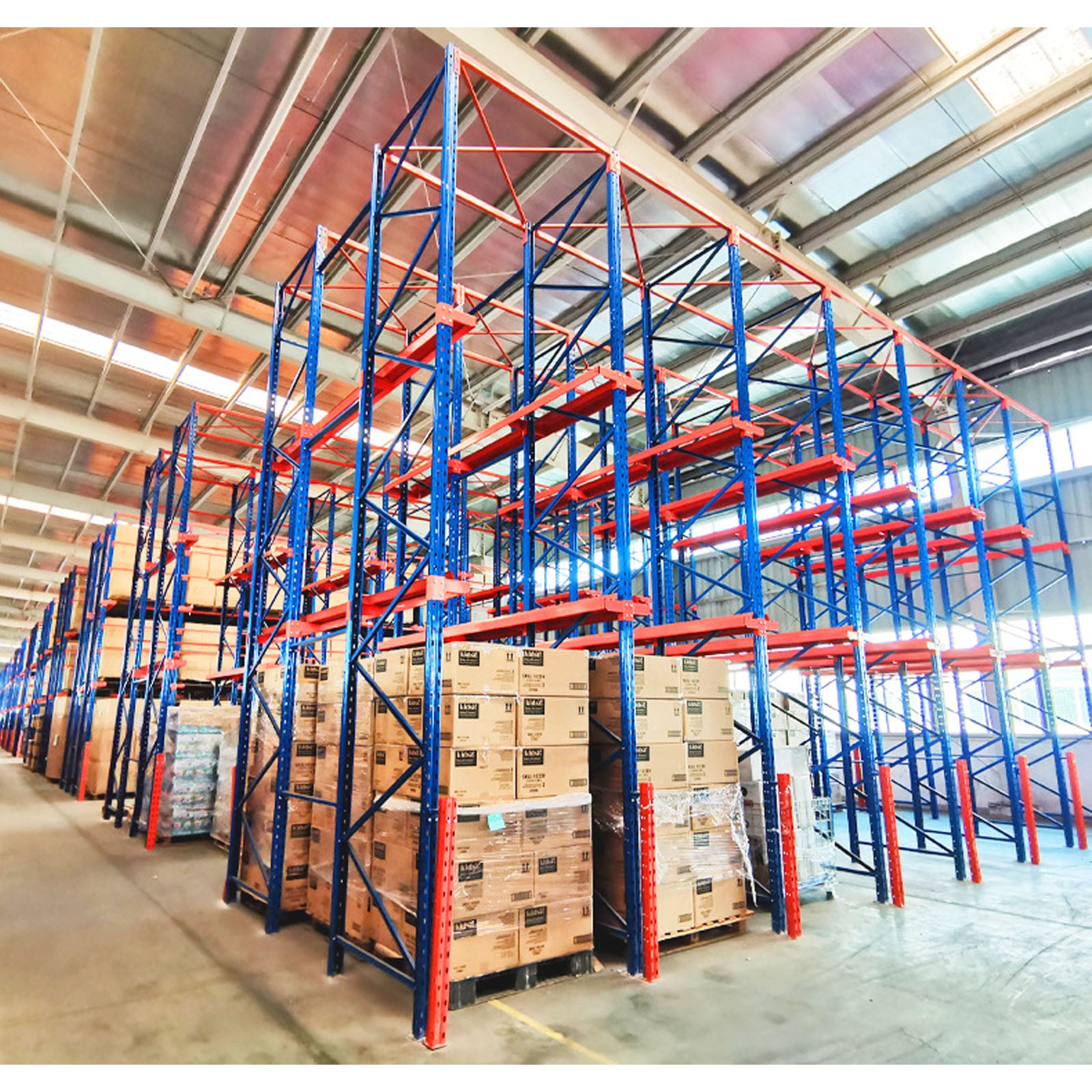
Double deep pallet racking works by storing goods in two rows side by side front and back, cutting down on needed aisle space and boosting overall storage capacity by around 30 to 40 percent when compared to regular selective systems. The setup needs special equipment though like deep reach forklifts equipped with those extendable forks or pantograph style mechanisms. Regular forklifts just won't cut it since they can't reach the pallets at the back safely. Warehouse staff working with this system need proper training because visibility is limited and moving around becomes trickier when accessing those rear stored items. These racks follow what's called the LIFO principle where whatever gets put in last comes out first. That means workers can't get to the stuff in the back until all the front items have been taken away first. While this arrangement saves valuable floor space, it does make certain products harder to access immediately. For businesses dealing with large volumes of inventory that doesn't rotate much and has steady demand patterns, double deep racking makes perfect sense despite these limitations.
Unlike selective racking's single-deep, aisle-per-row layout, double deep racking structurally merges two storage positions depthwise into a shared lane. This fundamental design shift drives key operational contrasts:
| Feature | Double Deep Racking | Selective Racking |
|---|---|---|
| Pallet Accessibility | 50% immediate access (front only) | 100% direct access |
| Inventory Method | Strict LIFO | Flexible (FIFO/LIFO) |
| Aisle Space | 40–60% reduction | Higher aisle footprint |
| Forklift Type | Deep-reach telescopic | Standard |
Operationally, selective racking supports random, velocity-driven SKU retrieval—ideal for high-variability inventories—while double deep suits uniform SKUs with predictable turnover. Its deeper load columns also require reinforced uprights and stricter weight distribution protocols to prevent rack deflection under sustained dual-pallet loads.
Double deep pallet racking gets more storage out of warehouse floors by rearranging layouts so less space goes unused. When warehouses arrange two rows of pallets facing each other in one access lane, they cut down on aisles by about 30 to 40 percent compared to regular selective systems. What this means is those old travel paths become actual storage areas instead of just empty space between shelves. Facilities that optimize their setup can gain up to 60% more usable storage room according to various industry reports and real world implementations across different sectors.
Getting more efficient comes down to cutting access paths in half basically. Take a warehouse where about half the floor space goes to aisles when using selective racking systems. Switching to double deep storage brings that down closer to 30%, which means roughly 20% extra room becomes available just for storing pallets. The space saved allows for around 40% additional pallet spots without needing any changes to the building size or structural framework. Industry reports back this up too showing that properly planned setups can actually achieve storage densities up to maybe even 60% higher than traditional methods. Makes sense really when looking at how much wasted space gets reclaimed through smarter layout choices.
A Midwest distribution center retrofitted with double deep pallet racking achieved measurable improvements:
Cutting down on aisle space using double deep pallet racking systems brings multiple cost savings over time. Warehouses that implement this approach often see their forklifts traveling significantly shorter distances since there are just not as many aisles to traverse. This reduction can bring down fuel usage and wear on equipment too. The lighting bill takes a hit as well when there's simply less area to illuminate, and heating/cooling expenses drop because climate control isn't needed across such vast spaces anymore. Warehouse staff find they get through their daily tasks faster without wasting time maneuvering between racks, which means facilities handling large volumes usually report around a quarter more output from their teams each day. Most businesses notice these efficiency gains pay off pretty quickly, often seeing return on investment somewhere around 18 months after installation, and this frequently means no rush to expand existing facilities or renegotiate expensive leases.
The system works best for businesses dealing with similar items that customers want regularly and in large volumes. Think of companies like soft drink distributors, frozen food packagers, or places storing bulk goods. When there are under 200 different stock keeping units (SKUs) in play, all the pallets fit the same specifications, and inventory moves through the warehouse at least four times per month, this setup really shines. Warehouses using this approach typically see their storage space utilization jump between 40 to 60 percent compared to traditional selective racking systems. The last-in-first-out (LIFO) method doesn't create much trouble here since everything gets used up in a regular pattern that's easy to track and manage over time.
Today's warehouse management systems are really good at solving the access problems that come with double deep storage setups. They do this by moving stock keeping units around based on what's selling fastest right now. The software keeps tabs on how often things get picked, seasonal trends, and when restocking happens. Fast moving products get bumped up front where workers can grab them quicker. Some industry reports from last year suggest this approach cuts down retrieval times about 30% on average. Another smart trick is strategic slotting. This means putting together items customers tend to buy together and placing hot sellers near the aisles so they're easy to reach. Combine all this with thermal imaging tech for forklifts, and warehouses see fewer mistakes happening back in those hard to reach storage areas. Not bad for something that wasn't possible just a few years ago.

 EN
EN
 Hot News